
Stand under the Sistine ceiling and look up. In the fourth bay of the vault, roughly nine metres above the floor, there is a panel about five and a half metres wide, and in that panel two hands reach toward each other. The fingers do not meet. On the actual ceiling the gap is maybe a few centimetres, and everything in the composition points to it. Every line, every gesture, every tilt of the two bodies is arranged around a space that could be closed in a second and never is.
Michelangelo painted this panel around 1511, four years into a commission he had not wanted. He had argued against taking the ceiling. He considered himself a sculptor and kept insisting so in letters, and the first months of the job were spent trying to find a way out of it. By the time he reached the Creation of Adam, he had already covered a large part of the vault with hundreds of figures, and he had worked out exactly how the fresco was going to behave. The panel is the result of that experience, and it is the one moment in the cycle where the whole theological argument of the chapel is held in a single gesture.
Where the Panel Sits and How It Was Painted
The panel is one of nine central scenes on the ceiling, and it sits roughly halfway down the vault, between the Creation of Eve and the Fall of Man. Michelangelo worked in buon fresco, the true fresco technique: pigments mixed with water, applied directly to wet lime plaster. The plaster is spread on the wall in sections, and each section has to be painted in a single day, because once the lime sets, the pigment is locked into the wall and cannot be corrected. The Italian word for these daily sections is giornate, and if you look at the surface from below at the right angle, you can still see the seams where one day's work ends and the next begins.
This means Michelangelo could not revise. He could not scrape off a mistake and start again. He had to plan the entire panel, transfer the drawing to the fresh plaster, and paint it in the hours before the lime went off. The Creation of Adam is roughly five hundred square feet of surface, and it was painted across a series of giornate, each one between twenty and thirty square feet. The seams run through the bodies. In some places they cut through the sky, and the blue is slightly different on either side, because one day's pigment was mixed a shade lighter than the next.
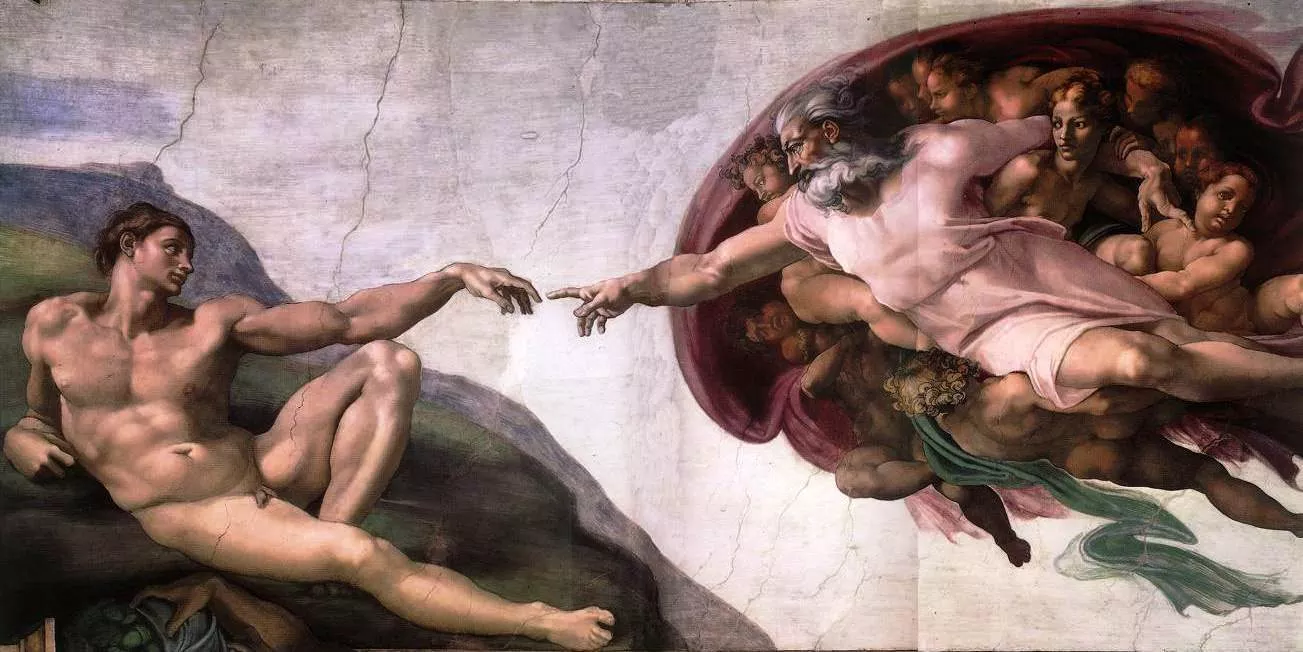 The Creation of Adam, painted around 1511. Fresco on plaster, roughly 280 by 570 centimetres. Sistine Chapel, Vatican. One of nine central panels on the ceiling.
The Two Bodies and the Gap Between Them
On the left side of the panel, a young man lies on the ground. He is naked, muscular, half awake. His left arm is folded under his head, and his right arm extends toward the centre of the composition, hand drooping slightly at the wrist, index finger lifted. On the right, a much larger figure is in flight, surrounded by a mantle and by a crowd of other figures caught in the cloth. His right arm is extended toward the young man, and his index finger is also lifted. The two fingers point at each other, and the tips are separated by a few centimetres of bare plaster.
Look at the young man's body. His head is turned slightly toward the reaching hand, but the eye does not look at it. His limbs are still relaxed, still heavy, and everything about the pose is passive. He is not yet alive, or only barely. The reaching figure is in motion: the mantle flares behind him, his hair moves, the smaller figures wrapped in the cloth are tumbling through the air. The whole right side of the panel is a wind. The left side is a body at rest, just beginning to respond to something it cannot yet see.
There is a small detail that usually gets missed. The young man's right hand is not reaching so much as drifting, and the index finger is not fully extended. The finger droops at the last joint, almost like a man who has fallen asleep with his hand on a table. The gesture on the other side is firm, sharp, deliberate. So one hand is trying, and the other is half-limp. The gap between the fingers is where the whole painting happens.
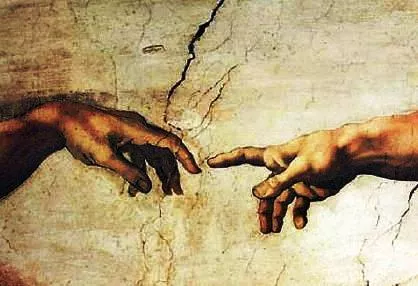 The gap between the fingers is a few centimetres of bare plaster. The hand on the left is half-limp. The hand on the right is firm. The whole panel is arranged around that difference.
The Shape Behind God
In 1990 an American physician named Frank Lynn Meshberger published a paper in the Journal of the American Medical Association arguing that the mantle and the crowd of figures on the right side of the panel form the outline of a human brain in cross-section. The shape of the mantle, he said, corresponds to the cerebral cortex; the tumbling figures inside it correspond to the structures of the brainstem and the spinal cord. Meshberger read this as Michelangelo, an experienced anatomist, encoding a second layer of meaning in the composition: God gives Adam not only life but also intellect.
The theory has been repeated so often that it now appears in most popular accounts of the panel. It has also been challenged. Art historians have pointed out that similar mantle shapes appear elsewhere in Michelangelo's work, and that the resemblance may be the result of the way Renaissance artists drew drapery rather than a deliberate anatomical reference. What is not in dispute is that Michelangelo had dissected human bodies by the time he painted the ceiling, and that he knew what a brain looked like. Whether he put one on the ceiling in the shape of God's cloak is a question that remains open.
Why Fresco Cannot Be Printed
Fresco is a matte surface. Oil painting, which was becoming the standard medium in Italy during Michelangelo's lifetime, produces a slightly reflective surface that catches light and moves with the viewer. Fresco does not. The pigment sits inside the plaster, not on top of it, and the surface reads as flat from every angle. The colours are chalky and pale, and the blues and greens have a quality that no oil painter could match. Fresco is also permanent in a way that oil is not, because the pigment is locked into the wall itself.
A digital print lays pigment in an even layer on paper or canvas. It flattens the surface and turns the fresco into a picture of a fresco. The giornate seams disappear. The slight variations in tone between sections of the sky, which are an essential part of how the panel actually looks, are ironed out into a single uniform blue. The white plaster, where Michelangelo left it bare between the fingers, becomes just another pale area of the print.
A hand-painted reproduction of a fresco is a contradiction in terms, because fresco cannot be reproduced on canvas. The best that can be done is a careful oil copy that mimics the fresco's palette and its matte finish. The painter works from high-resolution photographs, matches the chalky blue of the sky, and paints the flesh in the warm ochres and pinks Michelangelo used. The result is not a fresco. It is a translation of a fresco into oil, and it can hold the composition and the colour, but not the plaster, and not the giornate, and not the slight differences in tone that come from the wall itself.
What it can do is bring the two hands and the gap between them into your room at full scale. On a large canvas, the gesture is the same size as it is on the ceiling, and the eye reads it the same way. That is the part a photograph cannot give you. A photograph reduces the panel to a page or a screen, and the panel was never meant to be read at that size.
See The Creation of Adam as a hand-painted oil reproduction at oilpaintings.com. The two hands and the gap between the fingers are set at full scale, in oil on canvas. View the painting
What to Look For
If you ever see the panel in the Sistine Chapel, start with the left hand and count the giornate seams around it. They are visible if you look closely, especially in the skin of the torso, where the warm tones change subtly at the edges of each day's work. Then look at the gap between the fingers and notice how much bare plaster sits between them. Then look at the young man's face. He is not looking at God. He is looking toward him, but not quite, and the exact direction of his eye is one of the parts of the panel Michelangelo painted last.
The ceiling was painted between 1508 and 1512. Michelangelo was thirty-three when he started and thirty-seven when he finished. He did not want the commission. He wrote a sonnet during the work complaining about the paint dripping onto his face and his beard curling backward toward his chest. By the time he reached the Creation of Adam, the complaints had stopped. What he had instead was a technique he could control, and a panel that has been watched by millions of people for over five hundred years, all of them looking at a gap that is not closed.
A hand-painted oil reproduction on canvas, built to hold the composition and colour of the fresco at full scale.
Images: Wikimedia Commons (public domain) and Michelangelo Art (michelangeloart.org).